
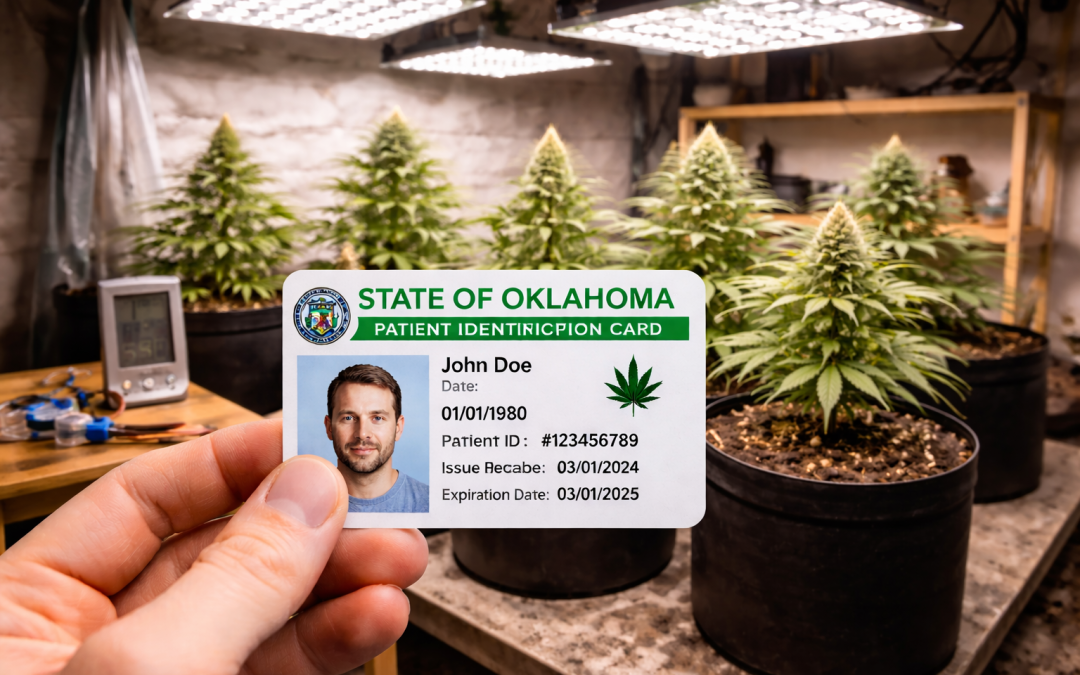
Most Oklahoma medical marijuana patients know they can buy from a licensed dispensary. Fewer realize they can legally home grow their own. The right to home grow is built directly into Oklahoma’s medical marijuana law, and it belongs to every licensed patient. This guide breaks down every rule for an Oklahoma medical marijuana home grow, what happens to your plants the moment your card expires, and how personal cultivation differs from a commercial grow license.
This post is informational only and does not constitute legal advice. Consult a licensed attorney for guidance specific to your situation.
Can Oklahoma Medical Marijuana Patients Legally Grow at Home?
Yes, licensed Oklahoma medical marijuana patients can legally grow at home. Home growing is one of the most generous patient rights in the state’s medical marijuana program. When voters passed State Question 788 in 2018, Oklahoma created one of the most patient-friendly programs in the country, and home grow rights were part of it from the start.
Under Oklahoma law, a licensed patient can cultivate cannabis plants at home for personal medical use. You do not need a separate commercial grow license. Your standard OMMA patient card is all you need. However, the grow must follow every rule OMMA has set. Violating any of them removes your legal protection.
You can verify the complete home grow rules on the OMMA’s official patient rights and responsibilities page.
How Many Plants Can You Grow With an Oklahoma Medical Card?
You can grow up to 6 mature plants and 6 seedlings with an Oklahoma medical card, for a total of 12 plants at any one time. These are the strict legal limits set by OMMA. Knowing them matters because growing even one plant over the limit removes the legal protection your card provides.
As a licensed patient, your Oklahoma medical marijuana home grow can include:
- Up to 6 mature marijuana plants
- Up to 6 seedling plants
- The harvested marijuana from those plants
That is 12 total plants in any state of growth. Keep your count accurate and documented. If you are unsure whether a young plant counts as a seedling or mature, OMMA generally classifies a plant as mature once it begins flowering.
Where Can You Legally Grow at Home in Oklahoma?
You can legally grow at home in Oklahoma only on property you own or rent with the written permission of the property owner, and only in an enclosed, locked space that is not visible from any adjacent street or property. Location rules trip up more patients than plant counts do, so read every part of this section carefully.
First, the grow must be on real property owned by the patient. If you own your home, you are clear on this point. If you rent, you must have the written permission of the property owner before any plant goes in the ground or under a light. A verbal “yeah, that’s fine” from your landlord does not count. Get it in writing. Our guide on the Oklahoma MMJ card and your landlord walks through exactly how to get the written permission you need.
Second, your plants cannot be visible from any public street or adjacent property. The legal standard is that plants must not be viewable by someone with normal 20/20 vision from any street next to your property. An outdoor grow that is visible from the road, sidewalk, or a neighboring yard does not meet this rule.
Third, the grow must take place in an enclosed, locked space. Plants must be secured and not accessible to anyone who is not your authorized caregiver or another patient. An unlocked garage, an open outdoor area, or any space accessible to the general public does not qualify.
The practical rule: grow indoors or in a secured, fully enclosed outdoor structure on property you own or have written permission to use, where no part of the grow is visible from outside the property boundary.
Can You Grow Marijuana Outdoors in Oklahoma?
Yes, you can grow marijuana outdoors in Oklahoma, but only if the outdoor grow meets every requirement: enclosed, locked, not visible from any adjacent street or property, and on land you own or have written permission to use. An open backyard garden does not meet these requirements. A fully enclosed and locked structure on your property, such as a secured greenhouse with locking doors, can qualify if it satisfies every visibility and access rule.
For most patients in neighborhoods or on smaller lots, indoor home growing is the simpler path to full compliance. Outdoor grows tend to make sense only for patients on rural acreage where visibility from public roads is not a real concern.
What Happens to Your Home Grow If Your Medical Card Expires?
The moment your OMMA card expires, every plant in your home grow becomes illegal. There is no grace period. Your cultivation rights end at expiration, even if you legally purchased the seeds, grew them under a valid card, and have been in full compliance the entire time.
This is one of the most important things every Oklahoma medical marijuana home grow operator needs to understand. Your legal protection to grow is tied directly to an active patient license. The day your card lapses, you go from a licensed patient with a legal home grow to an unlicensed person in possession of cannabis plants.
Home growers have an even stronger reason than other patients to renew on time. Start your renewal at least 30 days before your card expires so there is no gap in coverage. Our post on Oklahoma MMJ card renewal walks through every step of the renewal process.
Home Grow vs. Commercial Cultivation: The Critical Difference
Patient home grows and commercial marijuana cultivation in Oklahoma are completely separate legal frameworks. Confusing the two is one of the fastest ways patients accidentally break the law.
Your patient card gives you the right to grow up to six mature plants and six seedlings for your own personal medical use. That is the entire scope of the right. You cannot sell or give away your home-grown marijuana to any other person, licensed or not. Sharing cannabis with anyone is prohibited under Oklahoma law regardless of the recipient’s cardholder status.
Commercial cultivation, which means growing marijuana for sale to dispensaries and processors, requires a separate commercial grower license from OMMA. That license has its own application process, fees, background checks, and compliance obligations. It is also subject to an ongoing commercial licensing moratorium that has been in effect since August 2022 and currently runs through at least August 1, 2026.
Patient home grows are personal. Commercial grows are a regulated business. Keep the two fully separate and you stay legal.
Oklahoma Medical Marijuana Home Grow Rules at a Glance
Here is a plain-language breakdown of every rule you need to follow for a legal home grow in Oklahoma:
- Hold a valid OMMA patient license. No card, no legal grow. Your rights end the moment your card expires.
- Grow only on property you own or rent with written landlord permission. Verbal permission is not enough. Get it in writing.
- Keep your grow in an enclosed, locked space. Plants cannot be accessible to unauthorized people at any time.
- Keep plants out of public view. Nothing visible from any adjacent street or neighboring property to someone with 20/20 vision.
- Stay within the plant limits. Six mature plants and six seedlings, maximum. Going over removes your legal protection.
- Do not sell or share your harvest. Your home grow is for your personal medical use only. Sharing is illegal regardless of the other person’s card status.
- Renew your card before it expires. Your home grow rights end the instant your card lapses.
- Check local rules. Some Oklahoma cities, including Drumright, have additional local home grow ordinances that may require their own permit or notarized landlord consent on top of state requirements.
Does Home Growing Make Sense for Every Oklahoma Patient?
Not necessarily. An Oklahoma medical marijuana home grow takes time, space, equipment, and consistent attention. For many patients, buying from a licensed dispensary is simpler, more convenient, and more predictable. Oklahoma has hundreds of licensed dispensaries with tested, labeled products available statewide.
However, for patients with the space and interest, home growing offers real benefits: access to a wider variety of strains, lower long-term costs once setup is paid off, and a level of control over your medicine that dispensary purchases cannot match. It is one of the strongest patient rights in Oklahoma’s program, and it is worth understanding fully before you decide whether it is the right fit for you.
How to Get Your Oklahoma Medical Card and Unlock Home Grow Rights
Okie MMJ Doctor has helped over 50,000 Oklahoma patients get their medical cards since 2019. The physician visit happens entirely online and takes about 15 minutes. Same-day appointments are available Monday through Friday, 10am to 6pm.
Our physicians hold full Oklahoma licenses and complete every OMMA registration requirement under the 2026 SB 1066 rules, so your recommendation will be valid with the state.
Right now, book your visit for $69 using code OKIEDOC at checkout. That saves you $30 off the standard $99 fee. No recommendation, no charge, full refund, no questions asked.
Book your appointment with Okie MMJ Doctor and use code OKIEDOC to save $30.
Frequently Asked Questions About Oklahoma Medical Marijuana Home Grows
Do I need a separate license for an Oklahoma medical marijuana home grow?
No. Your standard OMMA patient card gives you the right to grow up to six mature plants and six seedlings for personal use. You do not need a separate commercial grower license to home grow.
Can I grow marijuana outdoors in Oklahoma?
Yes, but only if your outdoor grow is enclosed, locked, not visible from any adjacent street or neighboring property, and located on land you own or have written permission to use. For most patients in suburban or urban Oklahoma, indoor growing is the simpler path to full compliance.
Can I grow in a rental property?
Only with your landlord’s written permission. Oklahoma law requires home grow plants to be on property owned by the patient or grown with written permission from the property owner. A verbal agreement is not enough. An email reply confirming permission, a notarized letter, or a clause in your lease are all acceptable forms of written permission.
What happens to my plants if my Oklahoma medical card expires?
Your home grow rights end immediately when your card expires. Every plant becomes illegal at that moment, no matter how compliant you have been up to that point. Renew your card at least 30 days before expiration to avoid any gap.
Can I sell or give away marijuana I grow at home?
No. Home-grown cannabis is strictly for your own personal medical use. Selling it requires a commercial grower license. Giving it to any other person, including another licensed patient, is prohibited under Oklahoma law.
How many plants can I grow with an Oklahoma medical card?
Six mature plants and six seedlings, for a total of 12 plants at any one time. Growing beyond this limit removes the legal protection your patient card provides and exposes you to felony cultivation charges under Oklahoma law.
Does the OMMA inspect home grows?
OMMA does not routinely inspect patient home grows the way it inspects commercial growers. However, law enforcement can investigate complaints about visible plants, suspected commercial activity, or other violations. The fastest way to avoid an investigation is to keep your grow fully out of public view and within all plant limits.
Related Posts Worth Reading
- Oklahoma MMJ Card Renewal: Complete 2026 Guide
- Oklahoma MMJ Card and Your Landlord: What Renters Need to Know
- Do I Qualify for Medical Marijuana in Oklahoma?
Ready to get your Oklahoma medical card and start a legal home grow? Get started with Okie MMJ Doctor today and use code OKIEDOC to save $30 on your visit.
This post is informational only and does not constitute legal advice. Laws in this area continue to evolve. Consult a licensed attorney for guidance specific to your situation.