
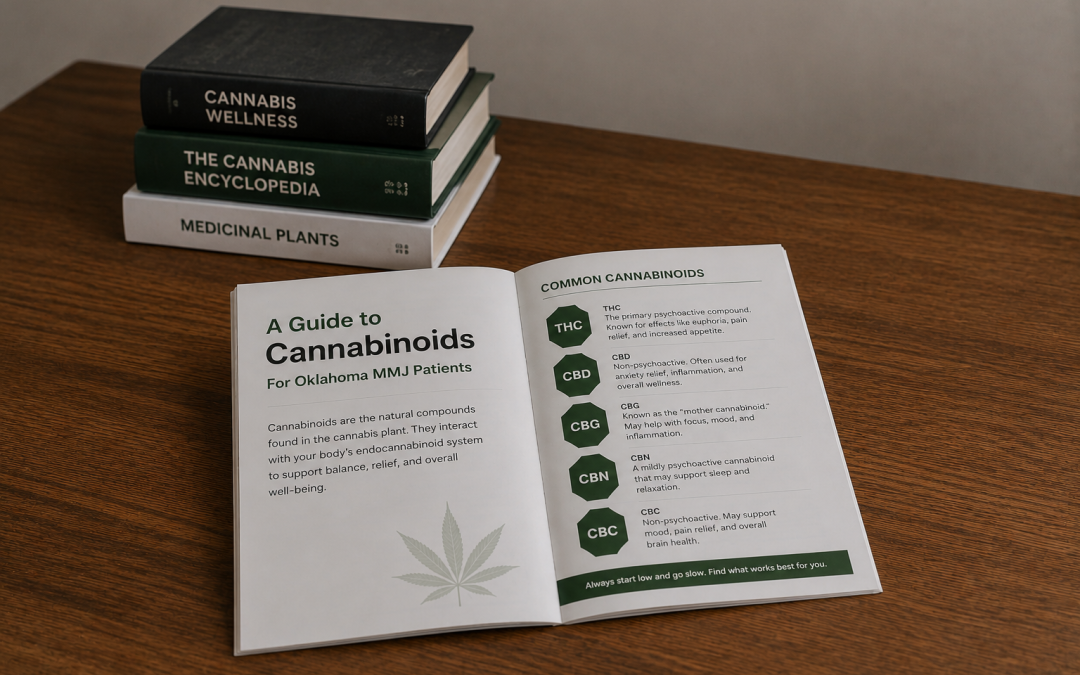
Cannabis contains more than 100 different cannabinoids, but most Oklahoma patients interact with a handful of key ones at dispensaries. THC produces the psychoactive effect and drives most pain and sleep benefits. CBD is non-intoxicating and has strong anti-anxiety and anti-inflammatory research behind it. CBG and CBN are minor cannabinoids gaining serious attention for inflammation and sleep. Understanding what each one does helps you make better choices at the dispensary and have a more useful conversation with your physician.
Walk into any licensed Oklahoma dispensary and you will see shelves full of products labeled with abbreviations: THC, CBD, CBG, CBN, CBC, THCA. New patients often have no idea what any of these mean or how to choose between them. Even experienced patients sometimes pick products based on habit or price without fully understanding what they are buying.
This guide covers the major cannabinoids found in Oklahoma dispensary products. It explains what each one does in the body, what the research actually shows, and what it means for you as a patient. Understanding cannabinoids is not just academic. It directly affects whether the products you choose actually help with your symptoms.
What Is the Endocannabinoid System and Why Does It Matter?
Before getting into individual cannabinoids, it helps to understand the system they interact with. Your body has a built-in regulatory network called the endocannabinoid system (ECS). Researchers only discovered it in the 1990s, but it has since become one of the most studied systems in the body. The ECS plays a role in regulating pain, mood, sleep, appetite, immune response, and inflammation.
The ECS works through two primary receptors found throughout the body. CB1 receptors concentrate in the brain and central nervous system. They connect most directly to psychoactive effects, pain perception, and mood. CB2 receptors are more common in immune tissue, the gut, and peripheral organs. They tie more closely to inflammation and immune response.
Cannabinoids from the cannabis plant are called phytocannabinoids. They interact with these receptors in ways that can amplify, mimic, or modify the ECS’s natural activity. That is the basic mechanism behind why cannabis affects pain, sleep, anxiety, and appetite. Different cannabinoids interact with the ECS differently, which is why THC and CBD produce such different effects despite both coming from the same plant.
What this means for you as a patient: the cannabinoids you choose at the dispensary are not all doing the same thing. Picking the right ones for your specific symptoms matters.
THC: The Primary Psychoactive Cannabinoid
Delta-9-THC, usually just called THC, is the most well-known and most researched cannabinoid in cannabis. It is the compound primarily responsible for the psychoactive “high” associated with marijuana. THC binds strongly to CB1 receptors in the brain, which produces the intoxicating effects and also drives many of its therapeutic benefits.
THC has the most extensive clinical research of any cannabinoid. Studies consistently show meaningful results for pain relief, nausea reduction, appetite stimulation, and sleep improvement. It is the primary reason patients with chronic pain, cancer-related symptoms, PTSD, and muscle spasms report significant relief from cannabis products.
THC also interacts with CB2 receptors, giving it anti-inflammatory properties alongside its central effects. Most full-spectrum Oklahoma dispensary products contain THC as the primary active ingredient.
Side effects to know about include temporary anxiety or paranoia in some patients, particularly at higher doses. Short-term memory effects during intoxication and coordination changes are also possible. Starting with low doses and adjusting gradually is the standard approach for new patients. The impairment THC produces is temporary and dose-dependent.
What this means for you: THC is not just about getting high. It is the most clinically validated cannabinoid for pain, nausea, and sleep. That also makes it the foundation of most medical cannabis products. Understanding your dose is the key to getting the benefit without the side effects.
CBD: Non-Intoxicating, Well-Researched, and Widely Used
Cannabidiol, or CBD, is the second most abundant cannabinoid in most cannabis strains. It has attracted the most mainstream attention over the past decade. CBD does not produce intoxication. It does not bind to CB1 receptors the way THC does, which means it will not make you feel high regardless of the dose.
Research on CBD is extensive and generally positive, particularly for anxiety, inflammation, and seizure disorders. Epidiolex, a CBD-based medication, has received FDA approval for specific types of epilepsy. This makes it one of the few cannabinoids with direct pharmaceutical validation. For anxiety, multiple studies show CBD can reduce subjective anxiety and physiological stress responses without the intoxicating side effects of THC.
CBD also appears to modify how THC works in the body. Higher CBD concentrations in a product may reduce the anxiety and paranoia some patients experience with THC. This is why many Oklahoma patients prefer balanced THC-CBD products over high-THC-only options.
One important distinction for Oklahoma patients: CBD products at licensed Oklahoma dispensaries are marijuana-derived, not hemp-derived. Hemp-derived CBD products sold in gas stations and health food stores are a completely different product category. Dispensary CBD products require your OMMA card and go through rigorous lab testing for potency and contaminants. Hemp-derived CBD products do not meet the same standards.
What this means for you: CBD is not a miracle cure, but it is genuinely useful for anxiety and inflammation. It also works as a complement to THC for patients who want therapeutic benefit with less intoxication. If you are sensitive to THC’s psychoactive effects, a higher CBD ratio is worth exploring.
CBG: The Mother Cannabinoid
Cannabigerol, or CBG, is called the “mother cannabinoid” because THC, CBD, and most other cannabinoids develop from its precursor compound CBGA during the plant’s growth cycle. By harvest time, most of the CBGA has converted into other cannabinoids, leaving most strains with less than one percent CBG. Selective breeding and modern extraction techniques have made CBG-rich products increasingly available at Oklahoma dispensaries.
CBG is non-intoxicating and does not produce a high. Unlike THC, which strongly activates CB1 receptors, CBG interacts with both CB1 and CB2 receptors more gently. Researchers describe this as a balancing effect on the endocannabinoid system rather than a strong activation of it.
Research on CBG is earlier-stage than research on THC and CBD, but the findings are promising. Studies show potential anti-inflammatory effects, particularly relevant for conditions like inflammatory bowel disease. CBG has demonstrated antibacterial properties in laboratory research, including activity against drug-resistant bacteria. Early research also suggests neuroprotective potential and possible benefits for glaucoma through reduction of intraocular pressure. However, human clinical trial data on these specific applications remains limited.
Oklahoma dispensaries increasingly carry CBG tinctures, capsules, and flower. Patients with inflammatory conditions, digestive issues, or those looking for a non-intoxicating complement to their THC or CBD routine are the most common CBG users.
What this means for you: CBG is worth exploring if you deal with inflammation, gut issues, or want a non-intoxicating cannabinoid option. The research is promising but still developing, so approach it as an addition to a broader cannabis regimen rather than a standalone treatment.
CBN: The Sleep Cannabinoid
Cannabinol, or CBN, forms as THC ages and breaks down through exposure to heat, air, and light. Older cannabis products tend to have higher CBN content. This gave rise to the longstanding belief that aged cannabis makes people sleepier than fresh cannabis. That belief turns out to have real science behind it.
CBN is a mild partial agonist at CB1 receptors. It interacts with the same receptor as THC but with much lower potency. Significant intoxication at normal doses does not occur. The sedative effects appear to come from a different mechanism than simple CB1 activation, and researchers are still working to fully characterize it.
A 2024 study from the University of Sydney’s Lambert Initiative used objective polysomnography measurements. Researchers found that CBN increased both non-rapid eye movement (NREM) and rapid eye movement (REM) sleep in rats. Effects on NREM sleep were comparable to the prescription sleep aid zolpidem. A separate 2024 randomized, double-blind, placebo-controlled human trial found that 20 milligrams of CBN nightly significantly reduced nighttime awakenings and overall sleep disturbance compared to placebo. The human evidence base for CBN is still developing, but these are the most rigorous findings the cannabinoid has had in decades of research.
Oklahoma dispensaries carry CBN products primarily in tinctures and capsules, often combined with THC or CBD to enhance the sleep effect. Patients dealing with insomnia, frequent nighttime waking, or PTSD-related sleep disruption report the most consistent results with CBN products.
What this means for you: CBN is the most evidence-supported minor cannabinoid for sleep. If nighttime waking or sleep quality is your primary concern, a CBN product or a CBN-THC combination is worth discussing with a dispensary staff member.
CBC: Anti-Inflammatory Support
Cannabichromene, or CBC, is one of the six major cannabinoids found in cannabis but is present in much smaller amounts than THC or CBD in most strains. CBC is non-intoxicating and does not bind strongly to CB1 or CB2 receptors. Instead, it appears to interact with other receptor types in the body involved in pain and inflammation signaling.
Research on CBC is less developed than research on the cannabinoids covered above. Early studies suggest anti-inflammatory, antidepressant, and analgesic properties. CBC also appears to interact with THC and CBD in ways that may enhance their effects. This makes it a contributor to the broader therapeutic profile of full-spectrum cannabis products even at low concentrations.
What this means for you: CBC is not commonly sold as an isolated product at Oklahoma dispensaries but is present in full-spectrum products. If anti-inflammatory effects are your primary goal, full-spectrum products that preserve CBC alongside THC and CBD may outperform single-cannabinoid options.
THCA: Why Raw Cannabis Does Not Get You High
Tetrahydrocannabinolic acid, or THCA, is the raw, unheated form of THC found in fresh and undried cannabis plants. THCA does not produce intoxication. It does not bind to CB1 receptors the same way THC does. The conversion from THCA to THC happens through heat, a process called decarboxylation. When you smoke, vape, or cook cannabis, THCA converts to active THC and produces the psychoactive effect.
This distinction matters for Oklahoma patients in two specific situations. First, patients who use raw cannabis products, such as fresh cannabis juice or certain tinctures made from undried plant material, are consuming THCA rather than THC. Those products will not produce intoxication. Second, THCA has its own emerging research on anti-inflammatory and neuroprotective properties that are separate from THC’s effects.
THCA is also relevant in the context of drug testing. Even though THCA itself is not psychoactive, the body metabolizes it in ways that can produce THC metabolites detectable on standard drug screens. Oklahoma patients who use any cannabis products and face workplace drug testing should understand that THCA-containing products can still trigger a positive result.
What this means for you: THCA is not the same as THC and does not get you high on its own, but it can affect drug test results and has its own therapeutic properties worth knowing about.
Delta-8 THC: How It Compares to Delta-9
Delta-8 THC is a cannabinoid that occurs naturally in cannabis in very small amounts. It is structurally similar to Delta-9 THC but with a slightly different molecular arrangement that produces milder psychoactive effects. Many Oklahoma patients know Delta-8 because it was widely sold in gas stations and smoke shops. The hemp loophole allowed high-THC hemp derivatives to be marketed legally, and Delta-8 was one of the primary products sold that way.
The key differences between Delta-8 and Delta-9 that matter for Oklahoma MMJ patients are potency, regulation, and consistency. Delta-9 THC products at licensed Oklahoma dispensaries are lab-tested for exact potency, pesticides, heavy metals, and microbial contamination. Delta-8 products sold outside the licensed dispensary system have not met the same testing standards, and product labeling has frequently proven inaccurate.
Federal law is also changing. A 2025 federal law takes effect November 12, 2026 and will effectively ban most Delta-8 and THCA products sold through the hemp market. It does this by applying a total THC limit that most of those products exceed. After that date, a licensed Oklahoma dispensary and an OMMA card will be the only legal, regulated path to high-potency cannabis products in the state.
What this means for you: if you have been using Delta-8 or THCA products from smoke shops, the regulated dispensary system offers more consistent, lab-tested products. It is also the only legal option after November 2026.
The Entourage Effect: Why Full-Spectrum Products Work Differently
The entourage effect is the idea that cannabinoids work better together than in isolation. First proposed in the late 1990s, the theory suggests that THC, CBD, CBG, CBN, CBC, and other compounds including terpenes all interact with each other. Those interactions change the overall therapeutic effect compared to using any single cannabinoid alone.
The evidence for the entourage effect is real but still developing. A 2024 double-blind clinical trial from Johns Hopkins and the University of Colorado found that combining THC with a terpene called d-limonene significantly reduced anxiety, nervousness, and paranoia compared to THC alone. That was one of the first direct clinical demonstrations of a cannabinoid-terpene interaction. A comprehensive 2024 review in Pharmaceuticals concluded that synergistic interactions are plausible and supported by some studies. However, definitive clinical proof across all claimed benefits is still pending.
The practical implication is meaningful. Full-spectrum products preserve the full range of cannabinoids and terpenes from the cannabis plant. Broad-spectrum products remove THC but preserve other cannabinoids. Isolates contain only a single cannabinoid. Many patients report more consistent results with full-spectrum or broad-spectrum products than with isolates, and this aligns with what entourage effect research suggests.
What this means for you: full-spectrum products may give you more complete therapeutic benefit than isolates, particularly for complex conditions involving pain, sleep, and mood at the same time. Ask your dispensary staff about full-spectrum versus isolate options for your specific symptoms.
How to Use This Information to Get Your Oklahoma MMJ Card
Understanding cannabinoids gives you a real advantage when you talk to your Okie MMJ Doctor physician. Instead of a vague description of your symptoms, you can have a specific conversation about which cannabinoids may be most relevant to your condition and what ratios might work for your situation. Knowing this also helps you identify what to look for at the dispensary once your card is approved.
Oklahoma’s physician discretion model means your doctor evaluates your individual situation without a checklist of qualifying conditions. A clear, specific description of your symptoms combined with an understanding of what each cannabinoid does gives your physician the information they need to make a useful recommendation for you.
For more on conditions that Oklahoma patients commonly address with medical marijuana, the Oklahoma MMJ qualifying guide walks through how the physician evaluation works and what to expect. The first-time Oklahoma dispensary guide covers what to expect on your first visit after you receive your card.
Ready to get started? Book your Okie MMJ Doctor appointment online today and use code STOPRX for $10 off. The telemedicine visit takes 15 minutes, all of our physicians are OMMA-registered and SB 1066 compliant, and same-day appointments are available Monday through Friday. Over 50,000 Oklahoma patients have trusted Okie MMJ Doctor with their recommendations since 2019.
Have questions about your specific situation before you book? Contact our team and we will help you figure out the right next step.