
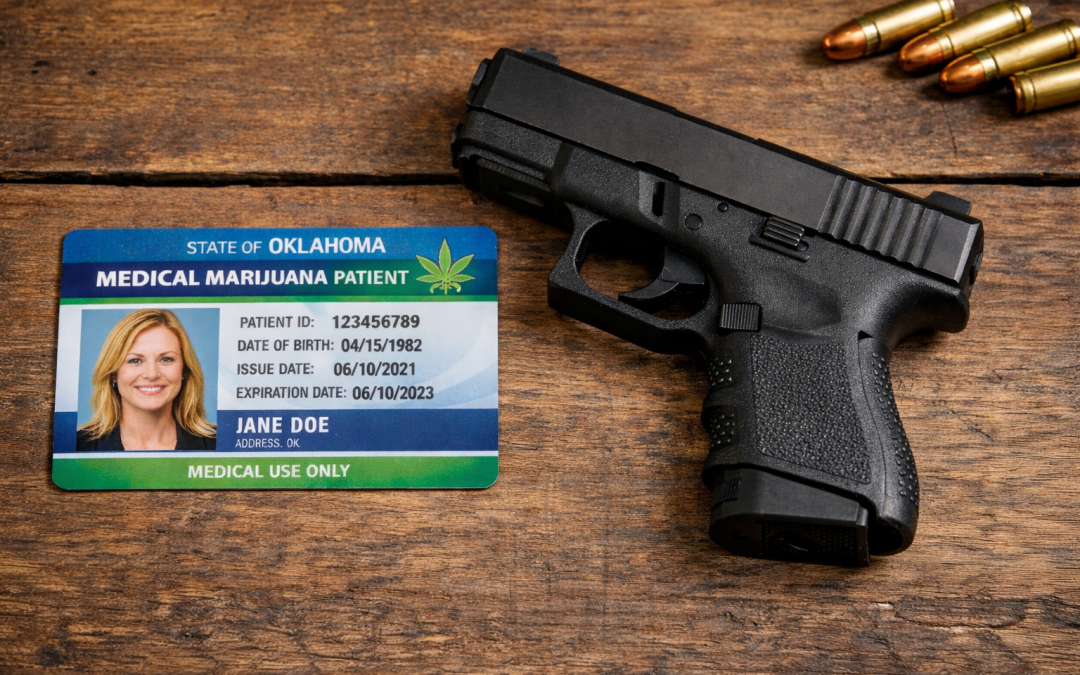
Many Oklahomans own firearms. Many of those same Oklahomans are considering a medical marijuana card. If that describes you, you probably want a straight answer before you do anything.
Here it is: Oklahoma state law protects your right to own firearms as an MMJ cardholder. Federal law is a different story. Read both sides before you decide.
This guide covers where things stand in 2026. It explains what Oklahoma has done to protect cardholders, what the federal conflict looks like, and which questions belong with an attorney.
Note: This post is informational only and does not constitute legal advice. Consult a licensed attorney for guidance specific to your situation.
What Oklahoma state law says about MMJ cards and firearms
Oklahoma leads the country in protecting the Second Amendment rights of MMJ patients.
Lawmakers moved quickly after voters passed medical marijuana in 2018. They wanted to make sure cardholders kept their gun rights. The result is one of the strongest state-level protections for MMJ patients in the nation.
Title 63 of the Oklahoma Statutes says it clearly. A medical marijuana patient or caregiver cannot lose the ability to purchase or carry a firearm based solely on their MMJ status. The state cannot deny you a firearm or firearm accessory because you hold an OMMA card.
In 2019, Oklahoma became a constitutional carry state through HB 2597. Eligible Oklahomans can now carry firearms openly or concealed without a permit. MMJ cardholders have this right too.
The following year, the Oklahoma Senate unanimously passed Senate Bill 959. That bill reinforced that the state cannot deny a concealed carry permit based on a person’s MMJ patient status.
The state-level bottom line: Oklahoma will not revoke your gun rights, deny you a handgun license, or penalize you for holding an MMJ card.
You can also verify this directly through the Oklahoma State Bureau of Investigation’s official guidance on the Self-Defense Act and medical marijuana.
The federal conflict every Oklahoma gun owner needs to understand
Here is where things get more complicated.
Federal law has not caught up with state medical marijuana programs. The federal Gun Control Act — specifically 18 U.S.C. § 922(g)(3) — prohibits anyone who is an “unlawful user of or addicted to any controlled substance” from possessing a firearm. The federal government still classifies marijuana as a Schedule I controlled substance. So federal law still treats active marijuana users as prohibited from owning firearms.
In 2011, the Bureau of Alcohol, Tobacco, Firearms and Explosives (ATF) sent a letter to all licensed gun dealers. The ATF told dealers they cannot sell firearms to anyone they know holds a medical marijuana card. The ATF has held that position ever since.
Oklahoma’s OMMA patient database does not connect to the FBI’s National Instant Criminal Background Check System (NICS). Your MMJ card will not appear on a standard background check. But that does not remove the federal issue entirely.
ATF Form 4473: The question every gun buyer faces
Every firearm purchase from a licensed dealer requires completing ATF Form 4473. Question 21(e) asks:
“Are you an unlawful user of, or addicted to, marijuana or any depressant, stimulant, narcotic drug, or any other controlled substance?”
The form adds a bolded warning directly after: “The use or possession of marijuana remains unlawful under Federal law regardless of whether it has been legalized or decriminalized for medicinal or recreational purposes in the state where you reside.”
This puts MMJ patients in a tough spot:
- Answering yes results in an automatic denial.
- Answering no as an active MMJ patient is a false statement on a federal form. That is a federal crime. The penalty can reach 10 years in prison and $250,000 in fines.
This is the most important issue for Oklahoma gun owners to understand. Oklahoma’s state protections do not reach federal forms. State law cannot override a federal requirement.
What about guns you already own?
Federal law targets active use of a controlled substance. It does not simply target holding a state-issued card.
Oklahoma state law does not require you to surrender firearms you already own. The state’s protections are explicit on this point. You keep your guns.
The federal prohibition still technically applies to possessing a firearm while you actively use marijuana. Individual enforcement is rare. But legal exposure exists — especially if a firearm is ever involved in an incident and your MMJ status comes to light.
Courts are pushing back — and things are changing
Federal courts are increasingly challenging the firearms ban for marijuana users. Some of that legal action happened right here in Oklahoma.
In 2023, a federal judge in Oklahoma ruled in United States v. Harrison that the federal ban was unconstitutional. The court found no historical basis for disarming people solely because they use cannabis. The Department of Justice appealed, so the decision did not become binding nationwide.
In January 2025, the Fifth Circuit Court of Appeals ruled that the federal firearms ban was unconstitutional as applied to marijuana users. The Fifth Circuit covers Texas, Louisiana, and Mississippi.
In January 2026, the ATF published an interim final rule. The rule narrowed the definition of “unlawful user.” The ATF now requires evidence of “regular and recent” use. Previously, any use within the past year could trigger the ban. The new rule also carved out “isolated or sporadic” use. A final rule follows after a public comment period ending mid-2026.
The legal landscape is shifting fast. It is moving faster than at any point since Oklahoma legalized medical marijuana. Talking to an attorney now makes sense if this issue directly affects your decisions.
Practical summary for Oklahoma MMJ patients who own guns
Here is a plain-language breakdown of where things stand.
- Oklahoma state law protects you. The state cannot deny you a handgun license or revoke existing firearms rights because of your MMJ card.
- Your OMMA record stays separate from federal background checks. A routine gun purchase check will not flag your MMJ status.
- Buying from a licensed dealer means completing ATF Form 4473. That form asks directly about marijuana use. Oklahoma state law cannot help you there.
- Private sales in Oklahoma do not require a background check. Federal law still technically applies to active marijuana users who possess firearms.
- Federal courts are pushing back. The constitutionality of this restriction is under serious challenge. But the federal law still stands today.
- Talk to an attorney if you have specific concerns. Find one who practices both firearms law and cannabis law in Oklahoma.
Are people skipping their MMJ card over this?
Yes — quite a few Oklahomans hold back. They worry about losing their gun rights. But based on everything above, the concern is often bigger than the reality at the state level.
Oklahoma’s protections are real. The federal conflict is also real. But it mainly affects one specific act: buying a new firearm from a licensed dealer while you actively use cannabis.
Tens of thousands of Oklahomans currently hold both a concealed carry license and an MMJ card. They navigate this every day. Oklahoma has done more than almost any other state to protect both rights. The key is knowing exactly where each framework applies.
Getting your Oklahoma MMJ card if you decide it is right for you
Okie MMJ Doctor has helped over 50,000 Oklahoma patients get their MMJ cards since 2019. The physician visit happens entirely online. It takes about 15 minutes. Same-day appointments are available Monday through Friday between 10am and 6pm.
Our physicians hold full Oklahoma licenses. They complete all OMMA registration requirements under the 2026 SB 1066 rules. Your recommendation will be valid with the state.
Right now, book your visit for $69 using code OKIEDOC at checkout. That saves you $30 off the standard $99 fee. No recommendation, no charge — full refund, no questions asked.
Book your appointment at Okie MMJ Doctor and use code OKIEDOC to save $30.
Frequently asked questions about MMJ cards and guns in Oklahoma
Will getting an MMJ card show up on a background check?
No. The OMMA database does not connect to the FBI’s NICS system. Your MMJ card will not appear during a routine firearm purchase background check.
Can Oklahoma revoke my concealed carry license if I get an MMJ card?
No. Oklahoma law bars the state from denying or revoking a concealed carry license based on MMJ patient status. The Oklahoma Senate confirmed this unanimously in 2020.
I already own guns. What happens when I get an MMJ card?
Under Oklahoma state law, nothing changes. You keep your firearms. The federal question depends on active use. Talk to an attorney if you want specific guidance on that side of it.
Can I carry a firearm into an Oklahoma dispensary?
Oklahoma’s constitutional carry law allows eligible residents to carry in many locations. Individual dispensaries set their own policies. Always check a business’s posted rules before you enter with a firearm.
Will this situation change soon?
It may. Federal courts are striking down the firearms ban as applied to cannabis users. The ATF narrowed its rules in January 2026. The law is moving. Following this area closely — or working with an attorney who does — is the best approach right now.
Related posts worth reading
- Can I Lose My Job for Having a Medical Marijuana Card in Oklahoma?
- Oklahoma SB 1066 Explained: What MMJ Patients Need to Know
- Do I Qualify for Medical Marijuana in Oklahoma?
Ready to get your Oklahoma MMJ card? Get started with Okie MMJ Doctor today and use code OKIEDOC to save $30 on your visit.
This post is informational only and does not constitute legal advice. Laws in this area are evolving. Consult a licensed attorney for guidance specific to your situation.