
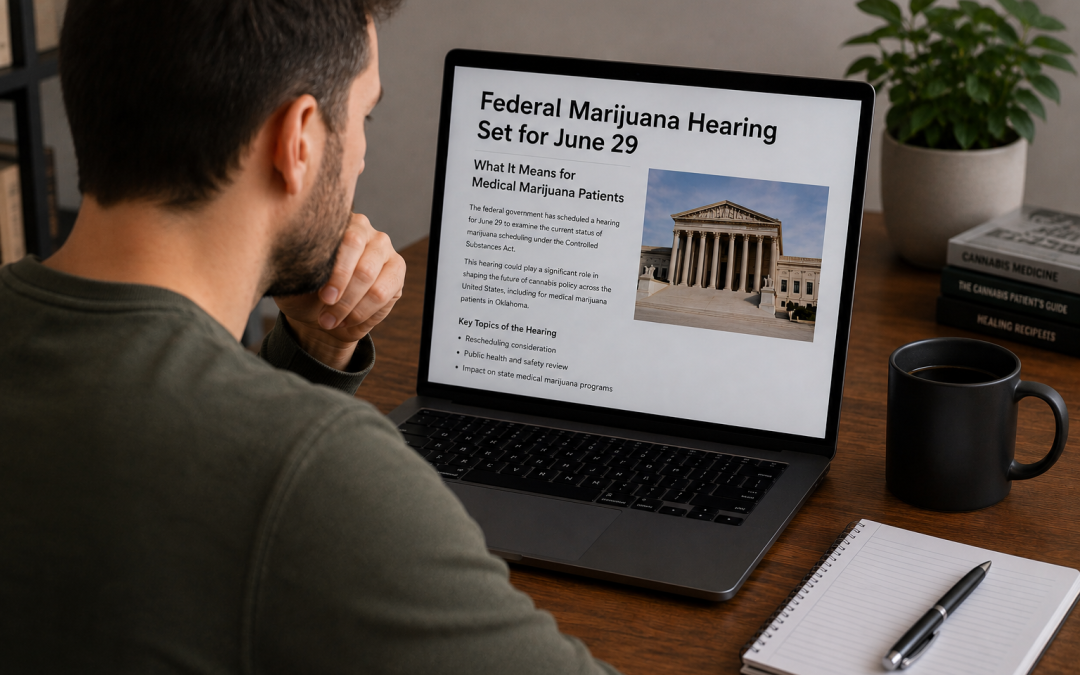
On June 29, 2026, the DEA begins a formal hearing on marijuana rescheduling under federal law. If you have a valid Oklahoma MMJ card, your medical marijuana is already federally rescheduled as of April 23, 2026. The June 29 hearing covers what happens next for the broader cannabis market. It does not affect your existing card or your rights as an Oklahoma MMJ patient.
Federal marijuana law is moving faster right now than it has in more than 50 years. Two major developments happened within days of each other in April 2026, and a third is coming on June 29. Oklahoma MMJ patients need to understand what each development actually means. The headlines have been confusing.
This post explains what happened on April 23 and what the June 29 DEA hearing is actually about. It also covers the possible outcomes for Oklahoma MMJ patients and why your OMMA card matters more than ever right now.
What Already Happened on April 23, 2026?
On April 23, 2026, Acting Attorney General Todd Blanche signed a final order from the Department of Justice moving state-licensed medical marijuana from Schedule I to Schedule III of the federal Controlled Substances Act. The order took effect immediately. Oklahoma’s OMMA program qualifies under that order. For the full breakdown covering patients, dispensaries, taxes, and SB 1066 compliance, the Oklahoma Schedule 3 guide has everything. This post focuses on what comes next.
What Is the June 29 DEA Hearing About?
The April 23 order was deliberately narrow. It rescheduled state-licensed medical marijuana immediately using a specific legal authority. However, it left broader marijuana policy to a separate formal process. That process begins on June 29.
A formal DEA administrative hearing begins June 29, 2026 at 9am Eastern at the DEA Hearing Facility in Arlington, Virginia. It concludes no later than July 15, 2026. At issue is whether all marijuana, including adult-use cannabis in states that have legalized it recreationally, should move to Schedule III under federal law.
This is a formal legal proceeding, not a public comment period. It involves evidence submission, expert testimony, cross-examination, and formal briefing. The outcome is not predetermined. Legal experts tracking the process note that a final rule could arrive as early as late 2026 if the hearing proceeds without major interference. However, court challenges, congressional action, or procedural delays could push that timeline into 2027 or beyond.
What Are the Possible Outcomes for Oklahoma Patients?
There are two basic directions the June 29 hearing could go. Neither one takes anything away from current Oklahoma MMJ patients.
If the hearing results in broader rescheduling of all marijuana to Schedule III, the change builds on what already happened on April 23. Adult-use cannabis gains federal recognition it does not currently have. For Oklahoma patients, this would reinforce existing protections. It could also ease some federal employment complications that affect card holders in federally regulated roles.
If the hearing does not result in broader rescheduling, or if legal challenges delay it, Oklahoma patients are not affected. State-licensed medical marijuana is already rescheduled. Your OMMA card, your legal right to purchase from licensed Oklahoma dispensaries, and your protections under Oklahoma state law all remain exactly as they are today.
Either way, the June 29 hearing does not change what you can do right now as an Oklahoma MMJ patient.
Does This Mean Marijuana Is Now Legal Under Federal Law?
No. Schedule III status means federal law treats state-licensed medical marijuana differently than before. However, it does not make marijuana federally legal in the same way alcohol or tobacco is legal. Federal controls still apply. Marijuana is still a regulated controlled substance. Moving across state lines with Oklahoma MMJ products is still prohibited. Federal employees and workers in federally regulated industries are still subject to federal drug testing policies.
Recreational marijuana in Oklahoma is not affected by any of this. Oklahoma voters have not passed a recreational legalization measure. Recreational cannabis remains illegal under both Oklahoma state law and federal law. Any change from the June 29 hearing would still need to interact with state law on the recreational side. Nothing changes for Oklahoma consumers who do not hold a medical card until that happens. However, recreational legalization remains a separate question entirely.
Why Does Your Oklahoma MMJ Card Matter More Than Ever Right Now?
Together, the April 23 order and the June 29 hearing represent the most significant federal validation of state medical marijuana programs in history. Licensed Oklahoma patients are now on the right side of federal law. Before April 23, that was not the case. That distinction carries real weight.
Patients without a valid OMMA card are not covered by any of this. Unregulated cannabis, products not purchased from a licensed Oklahoma dispensary, and use by unlicensed patients all fall outside the April 23 order entirely. The gap between holding a card and not holding one is wider now than it has ever been.
Keeping your card active through timely renewal is the simplest way to stay on the right side of both state and federal marijuana law. The Oklahoma SB 1066 guide covers the physician registration requirements that apply to every new and renewal recommendation in 2026.
What Does the June 29 DEA Hearing Mean for Oklahoma Patients With Federal Jobs?
This is one of the most important practical questions the June 29 DEA hearing raises for Oklahoma MMJ patients. Federal drug testing rules have not changed as a result of the April 23 order. Transportation Department policies have not changed. Defense Department policies have not changed either. Federal employees and safety-sensitive workers in federally regulated industries still face the same drug testing requirements they did before April 23.
What the June 29 hearing could change is the regulatory framework governing those policies. If broader rescheduling produces a final rule, federal agencies may need to revisit their marijuana testing standards. That process would take additional time and rulemaking beyond the June hearing itself. Also, legal experts note that even an optimistic timeline puts federal employment policy changes well into 2027 at the earliest.
For Oklahoma patients in federally regulated roles, including CDL drivers, federal contractors, Defense employees, and workers in aviation and rail transport, nothing has changed yet on the practical side. Your Oklahoma MMJ card provides strong state law protections in many employment situations. However, it does not shield you from federal drug testing requirements. Read the Oklahoma MMJ card employment guide for a full breakdown of where those state protections apply and where they do not.
Watch the June 29 hearing for this reason more than any other. A final rule extending Schedule III to all marijuana would pressure federal agencies to modernize drug testing policies. Those policies were written for a Schedule I world. That change does not happen automatically, but the hearing is the first formal step toward making it possible.
What Should Oklahoma Patients Do Right Now?
If your OMMA card is current, keep it that way. Set a reminder to begin your renewal at least 30 days before your expiration date. Under current Oklahoma law, an expired card eliminates both your state legal protections and your status as a federally recognized licensed patient under the April 23 order.
Now is a particularly good time to start the process if you have been considering getting a card. Oklahoma’s MMJ program is one of the most accessible in the country. There is no qualifying conditions list. Any licensed, OMMA-registered Oklahoma physician can recommend medical marijuana for any condition they believe may benefit from cannabis treatment. You can complete the entire process from home in a single day.
Schedule your Okie MMJ Doctor appointment online today and use code STOPRX for $10 off. The telemedicine visit takes 15 minutes. All of our physicians are OMMA-registered and meet the 2026 SB 1066 education requirements. Same-day appointments are available Monday through Friday. Over 50,000 Oklahoma patients have trusted Okie MMJ Doctor with their recommendations since 2019.
Have questions about how these federal changes affect your card or the renewal process? Contact our team and we will help you make sense of it.